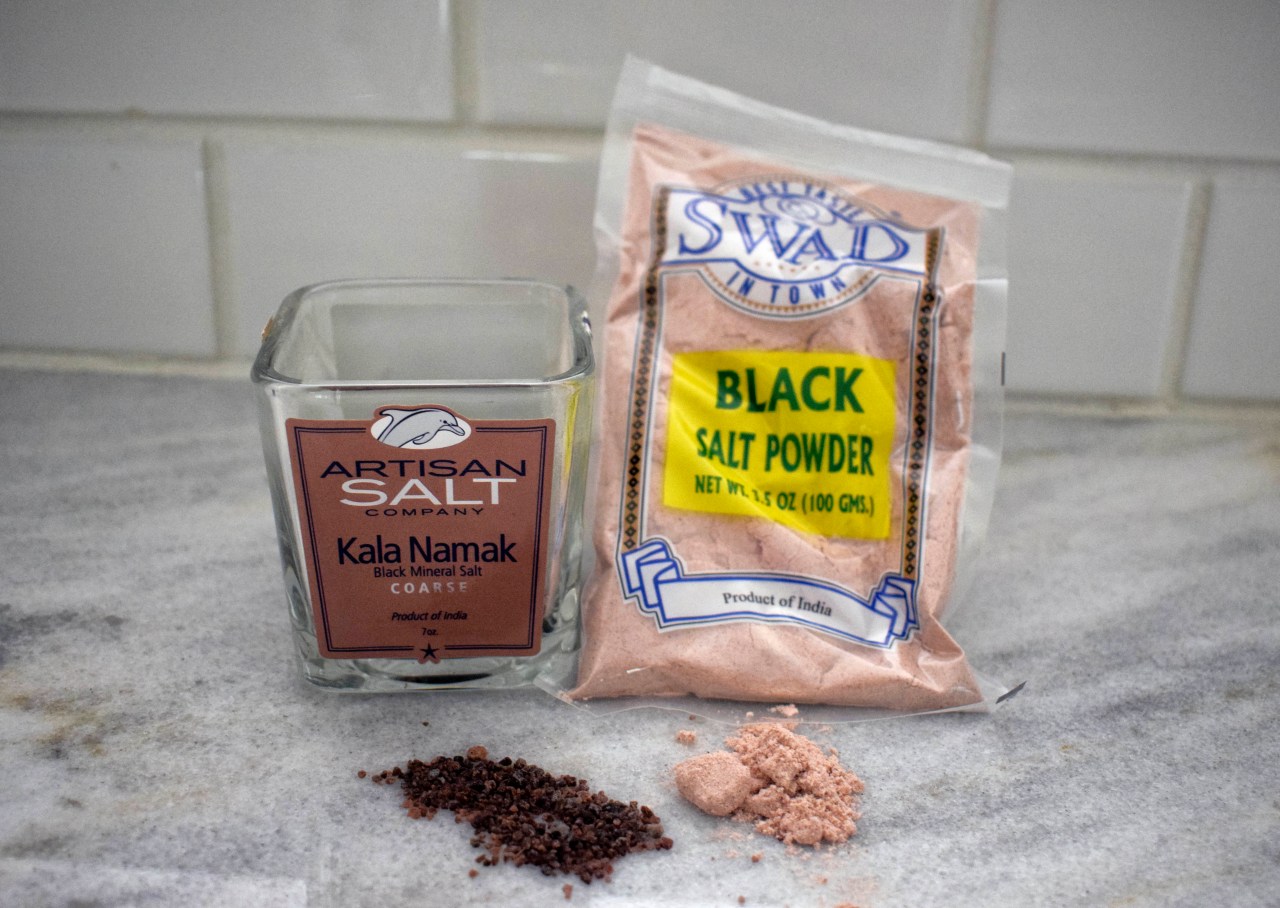
Is your table salt ever black? Well mine is! In my household I prefer to use Kala Namak salt.
I first learned about Kala Namak from a Nepalese masseuse I had in Hong Kong a few years back. Before she started the massage she gave me a questionnaire to fill out; one of the questions asked me if I had high blood pressure. I answered that, no, I did not have high blood pressure, but it was simply a little bit elevated (maybe 130/85). She later explained to me that back in Nepal she and others use Kala Namak salt to regulate blood pressure.
I decided to do some extended research on my own and soon came to find that indeed it has many health benefits*: less sodium but increased amounts of potassium, calcium and magnesium from regular table salt**. Along the way I also learned that several cooks use Kala Namak salt to receive its egg-like taste in some of their vegetarian or vegan dishes, such as vegan béchamel sauce.
I ordered some online and was eager to try it out, but the first time I added it to my food I was shocked! It had a very odd stench and I thought that I had ruined the food that I was making! Fortunately when I took a bite of my food, it tasted great and had that boiled egg-like taste. After that, I started to use Kala Namak in almost all my foods, and to this day think that it is much tastier than regular table salt. Even my little nieces prefer to use it!
Be it a neighboring passenger on a plane, or a cashier at a store, I often times find myself making conversation about cooking and love to listen to others to what cool tidbits they have for me. I have come to learn that some of the best tips I can give on cooking have come from other people I have met in passing in day-to-day life, and the most interesting tips are those that are culturally or regionally specific.
For example, people are often times surprised at how much sauerkraut Polish people seem to eat. When people ask me about it, I tell them that we often times eat it in the cold months of the year because it is a phenomenal immune system booster mainly due to its abundance of vitamin C! I subsequently got on the subject with a man sitting next to me on a flight one day. He pleasantly informed me on saindhav salt, a salt which is commonly used in Ayurveda medicine for people with kidney and respiratory problems. I too sometimes now use saindhav salt in those dishes, which I prefer not to have an eggy taste (when I’m baking a cake, for example).
* For more information on Kala Namak salt and its properties, you can visit: https://www.ayurtimes.com/kala-namak-black-salt-benefits-side-effects/
** One has to remember that Kala Namak is still a salt and that it still needs to be used in moderation for those who have the corresponding health issues.

 Veganiche